ELIEZYER
DE OLIVEIRA
How does the brain make memories last?
I am a neuroscientist studying how transient experiences produce lasting changes in the brain that allow memories to persist. Focusing on synaptic and circuit changes, I aim to understand how the brain self-organizes to form and stabilize new memories.
My work combines longitudinal tracking of synapses, circuits, and behavior, using imaging, molecular approaches, and population-level analysis to understand how fleeting experiences become stable biological traces in the brain. By revealing how memories stabilize across synapses and circuits, this work can identify mechanisms disrupted in psychiatric and neurological disorders, providing new treatment targets for preserving memory.
The key to brain function is within its intrinsic organization

Behavior
Behavior reveals how we learn and adapt in a changing world. Modeling it provides the opportunity to study the strategies behind these processes and study the neural circuits that underlie it.

Circuits and manifold
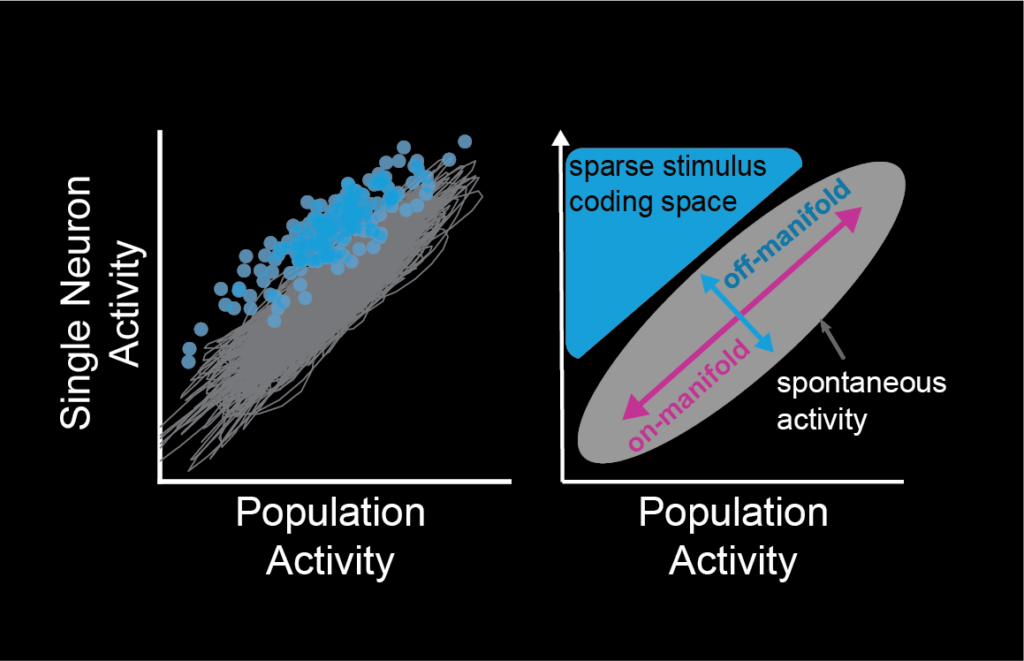
At the neural circuit level, cells are organized into a dynamical system that performs computations that drive behavior. This is often referred to as the manifold and is highly influenced by and dependent on cell-type and cell-state activity.

Molecular
Molecular states shape the composition and recruitment of neurons into computational processes. Understanding these molecular states provides a window into how neural circuits are remodeled and reshape behavior.
⊕